
Case study · Shopify · Built from scratch
NitroPress
NitroPress sells nitro cold brew makers from London into eighty currencies, in three machine tiers, alongside a spare-parts catalogue and a wholesale channel. We built the storefront from scratch, taking it from structure and UX planning through interface design to full development on Shopify.
The brand has since moved from NitroPress to Hatfields, and nitropress.com now redirects to hatfieldslondon.com. The site's own banner reads "NitroPress is now Hatfields." The rebrand and the domain move were not our work.
| Platform | Engagement | Industry | Region | Live site |
|---|---|---|---|---|
| Shopify | Built from scratch | Consumer hardware and speciality coffee | United Kingdom | hatfieldslondon.com |
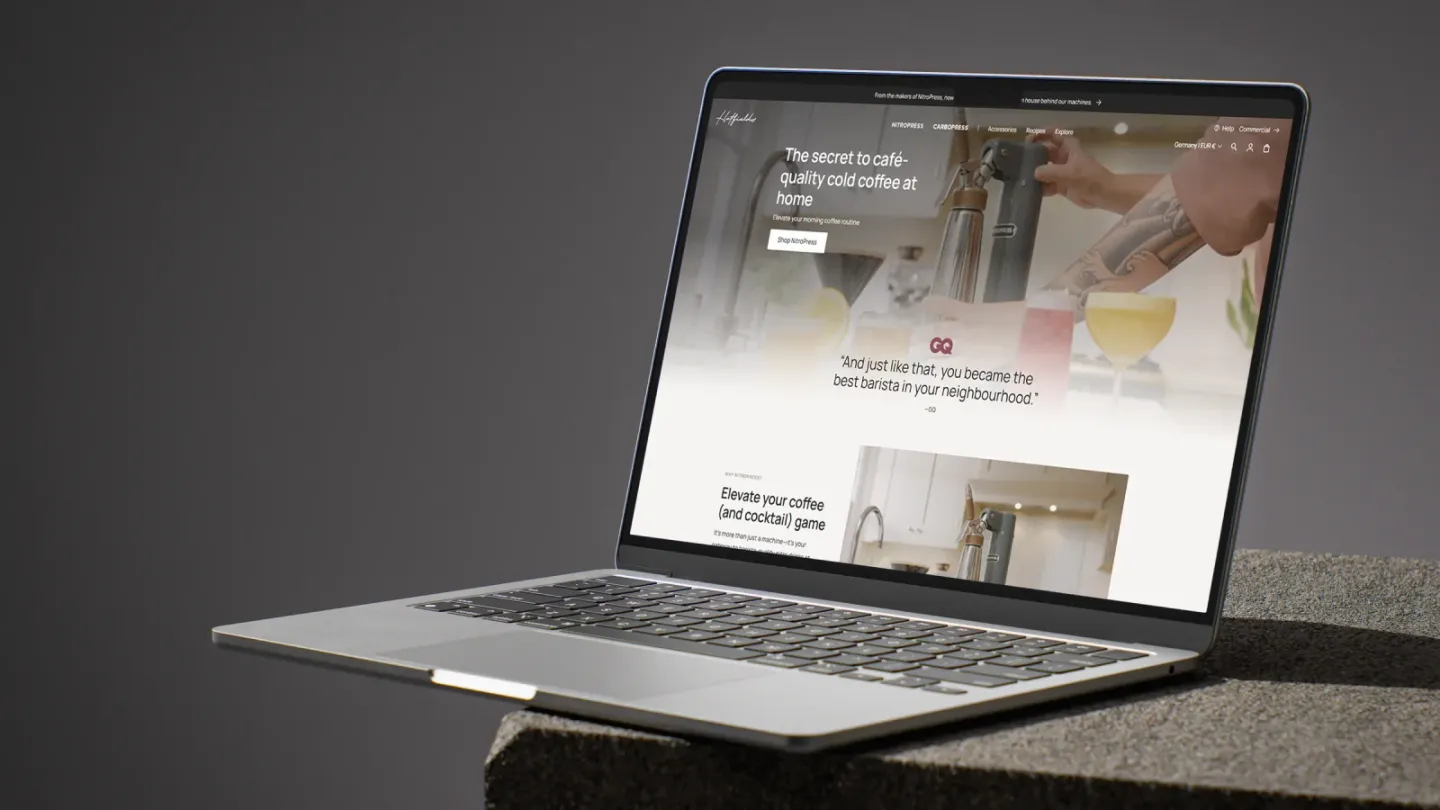
The storefront
The NitroPress store as it runs today, at hatfieldslondon.com. Screens change; this page describes the build rather than the current merchandising.
Open live siteThe challenge
Most direct-to-consumer coffee brands sell one machine into one market. This one sells three machine tiers, a consumables line, individually ordered gaskets and filter baskets, café-locator placement, an ambassador programme and pre-built commercial bundles — through a single storefront serving eighty currencies.
Every market added is a pricing decision. Every spare part added is a merchandising decision that earns almost nothing directly and decides whether a £400 machine is worth buying at all.
The approach
We planned the structure before designing anything, because the hard problem here is navigational rather than visual: a buyer choosing between three tiers and an owner hunting a replacement o-ring want opposite things from the same catalogue.
The build separates those journeys — tiered products lead the storefront, parts are reachable by machine rather than browsed as a catalogue, and the commercial bundles sit on their own path so wholesale enquiries never collide with consumer checkout. Interface design and full front-end development followed, with the currency selector and performance treated as build constraints rather than finishing touches.
What we did on this engagement
What the build carries
Four structural decisions do most of the work in this store. Each one is a constraint the design had to satisfy rather than a feature added at the end.
Shopify
The platform the storefront runs on, chosen for its multi-currency and multi-market handling.
Multi-currency storefront
Eighty countries and currencies are selectable, each needing a pricing decision rather than a conversion rate.
Tiered product architecture
Three machine tiers sharing one accessories and consumables range, so an accessory is authored once.
Spare-parts catalogue
Nozzle assemblies, filter baskets, o-rings, gaskets, adaptors and cartridge holders, findable by machine.
Notes from the build
Built from scratch, structure first
The storefront was planned before it was designed. A catalogue that has to serve three machine tiers, a consumables line, a spare-parts range and a wholesale channel is an information architecture problem wearing a visual brief, and getting the structure wrong is expensive to fix once the design is signed off.
What the brand states publicly
The site cites a Kickstarter launch supported by over 2,000 backers in a month, and carries a quote from GQ. Both are the brand’s own claims on the brand’s own site, and both belong to them rather than to us.
No figure on this page is presented as an outcome of our work. The engagement, scope and services listed above are the claims that are ours.
Questions this build answers
Three questions this project raised about building on Shopify, answered in the terms the work actually set.
What changes for a Shopify store selling in eighty currencies?
Selling into eighty currencies is a pricing problem before it is a technical one. The platform converts automatically, but a converted price often lands on an awkward number that reads as careless in a market you want to be taken seriously in. Each market needs a decision about rounding, and each decision has to survive a price change.
How do you keep spare parts findable without cluttering the catalogue?
Spare parts and machines want opposite navigation. Someone buying a machine is comparing three tiers; someone replacing a gasket already knows exactly what they need and wants it in two clicks. We route parts from the machine that uses them rather than listing them as a browsable range, so the parts catalogue never competes with the storefront.
Can one Shopify store serve both consumers and wholesale buyers?
It can, provided the two paths stay separate. Wholesale buyers want bundles, volume terms and a conversation; consumers want a single machine and a checkout. Putting both on one product page satisfies neither. This build gives commercial buyers their own entry point and their own bundles rather than a discount code on the retail range.
The services behind this build
Building something like NitroPress?
Whether it is a new store or one that already exists and needs work, the first conversation is about scope rather than a pitch.
We reply within one business day