Do you need Shopify Plus? The honest threshold
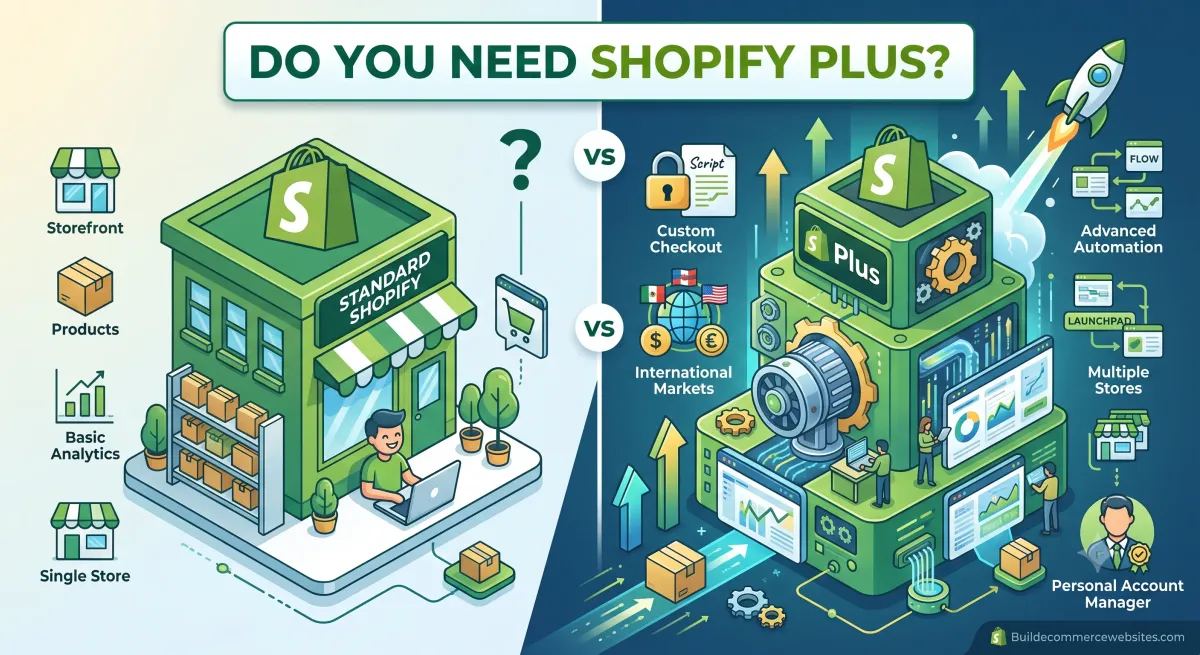
The honest test for Shopify Plus is not revenue, despite how it is sold. It is whether you need to modify the checkout. Below Plus, Shopify's checkout is closed — you can style it and nothing more. If your business needs custom logic at checkout, Plus is the only route on Shopify, whatever your turnover.
Shopify Plus is usually sold on revenue thresholds. That framing is convenient for a sales conversation and unhelpful for a technical decision, because the thing you are actually buying has nothing to do with turnover.
What you are actually buying
Checkout control. That is the honest answer.
Below Plus, Shopify’s checkout is closed. You can style it — colours, logo, some layout. You cannot change its logic. There is no way to add custom validation, conditional fields, bespoke steps, or business rules Shopify has not anticipated.
This is a deliberate platform decision and it is why Shopify’s checkout converts as well as it does. It is also an absolute ceiling if your business needs something the standard flow does not offer.
The questions that actually decide it
1. Do you need to change checkout logic?
Specifically, do you need any of these?
- Custom validation before an order can be placed
- Conditional fields based on cart contents or customer type
- Approval or purchase-order workflows
- Minimum order quantities enforced at checkout
- Bespoke tax or shipping logic beyond the built-in rules
- Age, licence or eligibility verification as a checkout step
One yes means Plus, if you are staying on Shopify. There is no workaround, and attempting one through apps produces a fragile arrangement that breaks on platform updates.
2. Do you sell to businesses on account terms?
Shopify’s B2B features — company accounts, multiple buyers per company, customer-specific catalogues and price lists, payment terms — are Plus-only.
Below Plus you can approximate wholesale through apps or a second storefront, but you end up maintaining parallel catalogues or accepting that trade customers check out like retail ones. If wholesale is a meaningful revenue share, that compromise costs more in operational friction than the plan difference.
3. Do your integrations hit API rate limits?
Plus raises them substantially. This matters for stores with heavy ERP synchronisation or high order throughput, and for almost nobody else. If you do not currently see rate-limit errors, this is not your reason.
4. Do you need multiple storefronts under one organisation?
Multiple markets with genuinely separate catalogues, or multiple brands, are easier to administer on Plus. Note that multi-currency and multi-region selling alone do not require Plus — Shopify Markets handles that on standard plans, and this is a common misunderstanding.
Reasons that are not reasons
Being candid about the ones we hear:
- “We’ve hit the revenue threshold.” There is no technical threshold. If nothing above applies, the plan buys you nothing you will use.
- “We want better support.” Real, but rarely worth the difference alone.
- “We want to look established.” Nobody outside your business can tell which plan you are on.
- “We need better performance.” Plus does not make your storefront faster. Your theme, your apps and your images do that.
If you are on Plus and cannot name which Plus-only feature you use, you are paying for a badge. That is worth checking — we have found it more than once during audits.
A note for existing Plus customers
Shopify replaced the old checkout.liquid customisation approach with Checkout Extensibility. If your Plus checkout was customised before that transition, those customisations need rebuilding as extensions.
This is not optional maintenance and it is not a small job on a heavily customised checkout. If nobody has raised it with you, raise it with whoever maintains your store.
What to do instead, if the answer is no
If none of the four questions applies, stay on a standard plan and put the difference into things that actually move revenue:
- Product photography, which is chronically underinvested in
- Fixing the information gaps on your product pages
- Auditing the apps slowing your store down
- Content that brings qualified traffic
Any of those will do more for a typical store than a plan upgrade nobody outside the business will notice.
What Plus does not fix
Worth naming, because these come up in the sales conversation and none of them is a Plus feature.
Performance. Plus does not make your storefront faster. Your theme, your apps and your images determine that, on any plan.
Conversion. The checkout is the same checkout below Plus unless you change it, and changing it is as likely to hurt as help without measurement.
Search rankings. No plan tier affects how you rank.
App costs. You still pay for apps, and Plus-tier pricing on some apps is higher.
A poorly structured catalogue. Plus gives you more control over checkout, not better product data.
If any of those is your actual problem, the plan upgrade is an expensive way to not solve it.
How the decision usually goes wrong
Two patterns we see repeatedly.
Upgrading too early, because revenue crossed a threshold somebody mentioned. The business pays materially more for features it does not use, and the money would have done more as photography, content or development.
Upgrading too late, having spent eighteen months and considerable development budget engineering around a checkout limitation that Plus would have removed. This one is more expensive, because the workaround usually has to be unpicked afterwards.
The way to avoid both is to answer the checkout question honestly at the start of a project rather than at the point of frustration. If the requirement exists, it exists now — it does not appear later.
If you are already on Plus and unsure
Three questions:
- Which Plus-only feature are you actually using? Name it specifically. Not “the support” — a feature.
- When did you last review the checkout customisations? If they predate Checkout Extensibility, they need rebuilding.
- Is the B2B functionality genuinely in use, or was it set up and abandoned?
If the answers are vague, it is worth modelling what a standard plan would cost you and what you would lose. Sometimes the answer is that Plus is well justified. Sometimes it is a legacy decision nobody has revisited.
A summary you can act on
Work through this in order and stop at the first yes:
- Do you need to change checkout logic? Yes → Plus.
- Do you sell B2B on account terms, at meaningful volume? Yes → Plus.
- Are your integrations hitting API rate limits today? Yes → Plus is worth costing.
- Do you run multiple genuinely separate storefronts? Yes → Plus is easier.
- None of the above? Stay on a standard plan.
If you reached five, the money is better spent on photography, product content, or fixing the information gaps on your product pages. None of those are as satisfying to buy as a plan upgrade, and all of them will do more for revenue.
Why this article exists
Because we have watched businesses upgrade for reasons that do not survive examination, and watched others spend eighteen months and a great deal of development budget engineering around a limitation that Plus removes in an afternoon.
Both are expensive, and both come from the same cause: the plan decision being framed around revenue rather than around what the checkout needs to do. Ask the checkout question at the start of a project and the answer is usually obvious.